- Description
-
- Creator(s)
- Thomas Girtin (1775-1802) and (?) Joseph Mallord William Turner (1775-1851) after John Robert Cozens (1752-1797)
- Title
-
- Monte Somma from the Loggia at Sir William Hamilton’s Villa at Portici
- Date
- 1794 - 1797
- Medium and Support
- Graphite and watercolour on wove paper, on an old mount
- Dimensions
- 14.8 × 23.5 cm, 5 ⅞ × 9 ¼ in
- Inscription
'1.0.0' lower left on the old mount; 'Girtin' on the lower centre of the old mount, not in the artist's hand; 'Girtin' on the back, not in the artist's hand; '127 / or / 137' in pen and ink on the back
- Subject Terms
- Hills and Mountains; Italian View: Naples and Environs
-
- Collection
- Catalogue Number
- TG0448
- Description Source(s)
- Viewed in November 2023
Provenance
Dr Thomas Monro (1759–1833); his posthumous sale, Christie's, 26–28 June and 1–2 July 1833 (day and lot number not known); probably acquired at the sale by Archdeacon Charles Parr Burney (1785–1864); then by descent
Bibliography
Bell and Girtin, 1935, p.57, no.242
Place depicted
Other entries in Monro School Copies:
Italian Views after Drawings by John Robert Cozens Made on the Second Italian Trip, 1782–83
Monte Somma from the Loggia at Sir William Hamilton’s Villa at Portici
Private Collection

The Temple of Venus at Baia
Private Collection

Entering the Tyrol: Unidentified Buildings amongst Wooded Hills
Tate, London

An Unidentified Fortress: Entering the Tyrol Region
Private Collection

A View on the River Inn, in the Tyrol
Tate, London

Innsbruck: St Anna's Column on Maria-Theresien Street
Victoria and Albert Museum, London

A Tree-Lined Valley, near Innsbruck
Private Collection

A Church Tower in the Valley of the Isarco, near Sterzing, in the Tyrol
Yale Center for British Art, New Haven

The Euganean Hills, Seen from the Walls of Padua
Tate, London

Part of Padua, Seen from the Walls
Private Collection

The Abbey of Santa Giustina at Padua
Yale Center for British Art, New Haven

The View from Mirabello, the Villa of Count Algarotti in the Euganean Hills
Private Collection

A Convent on Monte della Madonna in the Euganean Hills
Tate, London

Fano, on the Adriatic Coast
Private Collection

Terracina: The View from the Inn, with the Temple of Jupiter Anxur
Tate, London

Naples: The Villa Belvedere, Seen from Sir William Hamilton's Villa at Posillipo
Private Collection

Naples: The View from Sir William Hamilton's Villa at Portici
Private Collection

Portici: Mounts Somma and Vesuvius, from the Myrtle Plantation at Sir William Hamilton’s Villa
Tate, London

Naples: Solimena’s Villa and Pine Trees
Private Collection

Portici: The Fortress in the Royal Park, Looking towards Mounts Somma and Vesuvius
Tate, London

Portici: The Imperial Minister's Villa, near the Harbour of Granatello
Private Collection

Portici: The View from Sir William Hamilton's Villa, with Vesuvius in the Distance
Yale Center for British Art, New Haven

Portici: The Royal Palace, from the Park
Tate, London

The Coast at Portici, with the Villa d'Elboeuf in the Foreground and the Harbour of Granatello Beyond
Private Collection

The Shore at Portici
Fitzwilliam Museum, University of Cambridge

The Coast at Salerno, with Arechi Castle Overlooking the Town
Private Collection

The View from Salerno, Looking towards Vietri sul Mare
Tate, London

An Unidentified Villa in a Valley near Vietri sul Mare
Yale Center for British Art, New Haven

Salerno: An Ancient Cypress in the Garden of the Franciscan Convent
Tate, London

The Coast at Vietri sul Mare, from near Salerno
Victoria and Albert Museum, London

The Torre Crestarella at Vietri sul Mare, with Salerno in the Distance
Private Collection

The Cantilena Convent, near Vietri sul Mare
Tate, London

The Cantilena Convent near Vietri sul Mare, Seen from the Road
Private Collection

The Convent of San Francesco at Cava de' Tirreni
The Huntington Library, Art Museum and Botanical Gardens, San Marino

Naples: The Fifteenth-Century City Walls, with the Dome of Santa Caterina a Formiello
The Nelson-Atkins Museum of Art, Kansas City

View from the Road Leading to the Scuola di Virgilio, Showing Nisida, the Islands of Ischia and Procida, and the Promontory of Miseno
Private Collection, Norfolk

The Bay of Porto Paone, a Flooded Crater in the Islet of Nisida
Private Collection

Ancient Ruins on the Coast near the Point of Posillipo
Tate, London

Naples: The View from an Enclosed Road at Posillipo
Tate, London

Posillipo: The Palazzo di Roccella on the Shore
Private Collection

The Amphitheatre at Capua
Tate, London

A Ferry Crossing a River, on the Road between Eboli and Paestum
Tate, London

The View towards Salerno from the Road to Eboli
Yale Center for British Art, New Haven

Naples: Castel Sant'Elmo
Tate, London

The Royal Park at Astroni
Private Collection

Lake Agnano, Seen from Astroni
Private Collection

Naples: An Unidentified Convent, with Vesuvius in the Distance
Tate, London

Naples: A Range of Convents near Capodimonte, Including the Chinese College
The Whitworth, The University of Manchester

The Vanvitelli Aqueduct, near Caserta
Tasmanian Museum and Art Gallery, Hobart

The Royal Palace at Caserta, Seen from the Road to the Vanvitelli Aqueduct
Private Collection

The Convent of Santa Lucia, near Caserta
The Huntington Library, Art Museum and Botanical Gardens, San Marino

The Convent of Santa Lucia, near Caserta
Yale Center for British Art, New Haven

Ancient Ruins near the River Garigliano, Gaeta in the Distance
Private Collection

Florence: The Palazzo Vecchio, Seen from the Cascine Park
Tate, London

Florence: The Convent of Monte Oliveto, from the Banks of the Arno
Horne Museum, Florence

Florence: The Convent of Monte Oliveto, from the Banks of the Arno
Private Collection

The Villa la Massa on the Banks of the River Arno
Yale Center for British Art, New Haven

A Building amongst Trees, on the River Arno near Florence
Sphinx Fine Art, London

A View on the River Arno, with a Tower on a Hill
Tate, London

Florence: The Palazzo Vecchio from the Boboli Gardens, with Fiesole in the Distance
Harrow School, London

Florence: The View from the Boboli Gardens across the Valley of the Arno
Private Collection

A Villa, between Florence and Bologna
Ashmolean Museum, University of Oxford

A Wooded Shoreline on Lake Maggiore
Tate, London

Angera: The Borromeo Castle Overlooking Lake Maggiore
Tate, London

The Castle of Arona on Lake Maggiore
Private Collection

Lake Maggiore, from the Shore
Private Collection

Isola Bella on Lake Maggiore
Private Collection

Lake Maggiore, from Isola Bella
Yale Center for British Art, New Haven

A Distant View of the Grande Chartreuse
Private Collection

Buildings on a Promontory on the Coast at Posillipo
Private Collection

The Marmore Falls, near Terni
Private Collection

A Narrow Gorge Leading to the Grande Chartreuse
Private Collection

Florence: The View from the Grand Duke's Garden
Private Collection
Footnotes
- 1 The full diary entry, giving crucial details of the artists’ work at Monro’s house, is transcribed in the Documents section of the Archive (1798 – Item 2).
- 2 The paper was made transparent by the addition of varnish.
- 3 Joseph John Jenkins (1811–85) recorded an anecdote told to him by James Holland (1800–70) (Jenkins, Notes, 1852). See the Documents section of the Archive (1865 - Item 1).
- 4 This may have been when Girtin’s name was inscribed on both the front and back of the mount.
Revisions & Feedback
The website will be updated from time to time and, when changes are made, a PDF of the previous version of each page will be archived here for consultation and citation.
Please help us to improve this catalogue
If you have information, a correction or any other suggestions to improve this catalogue, please contact us.
About this Work
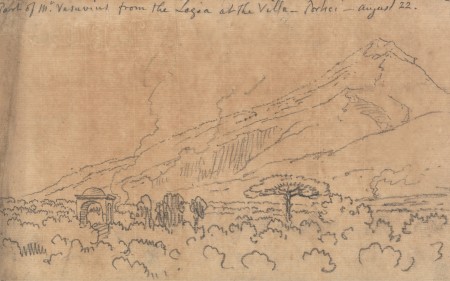
This view of Monte Somma taken from the loggia at the villa of Sir William Hamilton (1730–1803) at Portici was developed from a sketch made by John Robert Cozens (1752–97) in 1782 (see the source image above). The villa belonging to the British envoy was situated close to the newly excavated ruins at Herculaneum and provided a good view of Vesuvius and its extinct neighbour, Monte Somma. The watercolour was produced at the home of Dr Thomas Monro (1759–1833), where Girtin and his contemporary Joseph Mallord William Turner (1775–1851) were employed across three winters, probably between 1794 and 1797, to make ‘finished drawings’ from the ‘Copies’ of the ‘outlines or unfinished drawings of Cozens’. The majority of the resulting watercolours saw the two artists engaged in a unique collaboration; as they later recalled, Girtin ‘drew in outlines and Turner washed in the effects’. ‘They went at 6 and staid till Ten’ and, as the diarist Joseph Farington (1747–1821) reported, Turner received ‘3s. 6d each night’, though ‘Girtin did not say what He had’ (Farington, Diary, 12 November 1798).1
Monro’s posthumous sale, in 1833, contained only twenty or so sketches by Cozens, so the patron must have borrowed the majority of the ‘outlines or unfinished drawings’ copied by Girtin and Turner (Christie's, 26–28 June, 1–2 July). In this case, the source of the watercolour, a simple outline inscribed ‘Part of Mt. Vesuvius from the Logia at the Villa – Portici – august 22.’, was almost certainly purchased at Cozens’ studio sale in July 1794 by Sir George Beaumont (1753–1827).2 As Kim Sloan has noted, Beaumont mounted ‘215 “tracings” or drawings on oiled paper’ in an album that he presumably lent to Monro, and it was from this collection, now at the Yale Center for British Art, New Haven, that the two young artists produced more than fifty watercolours (Sloan and Joyner, 1993, pp.89–91). The source drawing was traced by Cozens himself from an on-the-spot sketch he made in 1782 on a second visit to Italy (Bell and Girtin, 1935, no.242), when the artist travelled with his patron William Beckford (1760–1844) and stayed in the Naples area for four months. The sketch is contained in the second of seven sketchbooks that survive from the trip (The Whitworth, Manchester (D.1975.5.11)) and it was presumably traced by Cozens because the books themselves were retained by Beckford.
The drawing came from the collection of Charles Parr Burney (1785–1864) who almost certainly acquired a significant number of works at Monro’s posthumous sale in 1833. According to a later, but reliable source, ‘Dr Burney and Turner met in the sale room’ where Turner is said to have expressed his displeasure, stating ‘that you have the bad taste to admire these things more than those I do now’. Burney’s reply, ‘that I admire every thing you do Mr Turner’ was enough to placate the artist and he added that ‘Perhaps they are not so bad for a half a crown! and ones oysters!’.3 There are perhaps as many as a dozen Turner and Girtin collaborations that have a Burney provenance and all presumably came from the Monro sale. The five-day sale included more than a hundred items attributed to Girtin and nine hundred by Turner only around half of which have been identified either as collaborations between the two artists or much less commonly as by Girtin alone. The Cozens copies that can be confidently given to Girtin include a fine large-scale view of Vallombrosa Abbey (TG0669) and another southern Italian scene based on a composition Cozens sketched in 1782, The View towards Salerno from the Road to Eboli (TG0735). Unlike the latter, this smaller drawing is directly related to the tracing, following its scale exactly, but as with Part of Padua, Seen from the Walls (TG0705) it too appears to be work of Girtin alone. The pencil work is certainly by him and although the colour is not applied in large areas of flat wash in a manner that marks out the larger Italian views as characteristic of Girtin’s work from around 1796-97, the palette and the touch is not something one associates with Turner’s work and I am reasonably confident that the drawing equates with one of the ‘Italian landscapes’ or ‘views in Italy’ sold at Christies in 1833 as by ‘Girtin’ (Christie’s, 1 July 1833, lot 105, Christie’s, 28 June 1833, lots 156, 160 163).4
1797 - 1798
Vallombrosa Abbey
TG0669
1798 - 1799
The View towards Salerno from the Road to Eboli
TG0735
1794 - 1797
Part of Padua, Seen from the Walls
TG0705