- Description
-
- Creator(s)
- Thomas Girtin (1775-1802) and John Masey Wright (1777–1866)
- Title
-
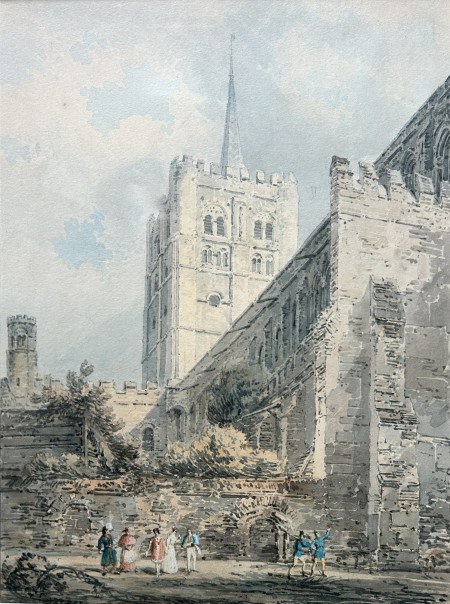
- St Albans Abbey, from the North West
- Date
- 1794 - 1795
- Medium and Support
- Graphite, watercolour and bodycolour on wove paper, on an early mount
- Inscription
'KING HENRY VI. PART II. ACT II. SCENE I / ST. ALBANS. KING HENRY. QUEEN MARGARET. CARDINAL. FALCONERS &C / KING HENRY But what a point, my Lord, your Falcon made / And what a pitch she flew above the rest!' on the mount
- Object Type
- Collaborations; Studio Watercolour
- Subject Terms
- Gothic Architecture: Cathedral View; Hertfordshire
Provenance
John Tyrrell (unknown dates); his posthumous sale, Christie's, 28 May 1874, lot 145 as ‘King Henry VI.: St. Albans – King Henry, Queen Margaret, Cardinal, Falconers, &c. Figures by J. M. Wright’ as by Joseph Mallord William Turner; bought by ‘Agnew’ for £73 10s; Thos. Agnew & Sons; Sir Joseph Heron (1809–89); his posthumous sale, Christie’s, 9 June 1890, lot 82; bought by 'Price' for £42
Place depicted
Other entries in London and the Home Counties, Together with Miscellaneous Studies and Views

Windsor Castle, from the River Thames
Harvard Art Museums / Fogg Museum


Great Bookham Church, from the East
Private Collection, Norfolk


Windsor Park and Castle, from Snow Hill
Anglesey Abbey, Cambridgeshire (National Trust)


The Gateway, St Albans Abbey
Ashmolean Museum, University of Oxford

St Albans Abbey: The West Porch
Yale Center for British Art, New Haven

St Albans Abbey: The West Porch
Yale Center for British Art, New Haven

St Albans Abbey, from the North West
National Gallery of Canada, Ottawa
St Albans Abbey, from the North West
Private Collection


An Interior View of St Albans Abbey, from the Crossing
Art Gallery of South Australia, Adelaide

The Interior of St Albans Abbey
Blackburn Museum and Art Gallery

Windsor Castle and the Great Park, from the South West
Private Collection, Norfolk

Windsor Great Park: Herne’s Oak with a Herd of Deer
Yale Center for British Art, New Haven


Stags Fighting amongst a Herd of Deer in Windsor Great Park, with the Castle in the Distance
Private Collection

A Herd of Deer in Richmond Park
Private Collection

A Panoramic View of the Thames from the Adelphi Terrace, Section One: Somerset House to Blackfriars Bridge
Private Collection

A Panoramic View of the Thames from the Adelphi Terrace, Section Two: The Surrey Bank
Private Collection

A Panoramic View of the Thames from the Adelphi Terrace, Section Three: Westminster Bridge to York Stairs
Private Collection

Westminster, from the West Corner of the Adelphi Terrace
Private Collection

The Thames with St Paul's and Blackfriars Bridge
The Morgan Library & Museum, New York

Shipping on the Thames, Looking down Limehouse Reach towards Greenwich, with the Church of St Alfege in the Distance
Private Collection


A Haystack on a Farm, on the Road to Harrow-on-the-Hill
Private Collection

A Panoramic Landscape, near Norwood
Private Collection

Westminster Abbey, Seen from Green Park and the Queen's Basin
National Gallery of Art, Washington

St Paul’s Cathedral, from St Martin’s-le-Grand
Yale Center for British Art, New Haven

St Paul's Cathedral, from St Martin’s-le-Grand
Untraced Works

St Paul’s Cathedral, from St Martin’s-le-Grand
Private Collection

St Paul’s Cathedral, from St Martin’s-le-Grand
Metropolitan Museum of Art, New York

A River Scene, with Boats
Victoria and Albert Museum, London

An Imaginary Coast Scene with the Horizontal Air Mill at Battersea
Private Collection

London: The Leathersellers’ Hall
British Museum, London

London: The Interior of the Ruins of the Leathersellers’ Hall
British Museum, London


Turver’s Farm, Radwinter
Yale Center for British Art, New Haven


A Farm with an Unidentified Windmill
Private Collection

Barns and a Pond, Said to Be near Bromley
Rhode Island School of Design Museum, Providence

Barns and a Pond, Said to Be near Bromley
Private Collection, Norfolk

Trees and Pond, Said to Be near Bromley; A Slight Sketch of a Man
Yale Center for British Art, New Haven

A Sandpit, near Logs Hill, Widmore
Private Collection

A Sandpit, near Logs Hill, Widmore
Private Collection


The Church of St Mary the Virgin, Stone-next-Dartford
British Museum, London


A Farmhouse in a Woodland Setting, Said to Be in Devon
Yale Center for British Art, New Haven


Farm Buildings, Probably in Surrey
The Whitworth, The University of Manchester

Tintern Village, Seen across the Forge Pond, Formerly Known as ‘The Mill-Pond’
Private Collection

A Picturesque House Overlooking a River, with Distant Windmills
Sidney and Lois Eskenazi Museum of Art, Indiana University, Bloomington


The West End of an Unidentified Church
Private Collection

Effingham Churchyard, Formerly Known as 'A Country Churchyard'
Fitzwilliam Museum, University of Cambridge

An Unidentified Windmill, Probably in Lambeth
Sarah Campbell Blaffer Foundation, Houston


Unidentified Buildings, Herne Hill
The Huntington Library, Art Museum and Botanical Gardens, San Marino

Study of a Sailor on Board a Ship; A Fishing Boat
Private Collection


The Frozen Watermill, from William Cowper's The Task
The Huntington Library, Art Museum and Botanical Gardens, San Marino


An Unidentified Subject, Probably from James Macpherson’s Poems of Ossian
Tate, London

The Eruption of Mount Vesuvius
The Morgan Library & Museum, New York

The Archangel Gabriel Awaiting Night, from John Milton's Paradise Lost
Yale Center for British Art, New Haven


A Study of a Woman Reading; A Slight Study of a Seated Woman
Private Collection


Portrait Study of a Man, Said to Be the Artist George Barret the Younger
Private Collection


A Study of a Lion from the Tower of London
Private Collection


An Open Field with a Cart and Horses, Known as ‘The Carter’
British Museum, London

A Church Seen across Fields, with Another Sketch Depicting a Woman
The Huntington Library, Art Museum and Botanical Gardens, San Marino

A Landscape with Figures by Railings
Fine Arts Museums of San Francisco

Self-Portrait of the Artist at Work
British Museum, London

An Unidentified Landscape, with a Church amongst Trees
Yale Center for British Art, New Haven

A Cottage and a Windmill Surrounded by Trees
Private Collection

St Paul’s Cathedral, from the Thames
Fine Arts Museums of San Francisco

The Head of a Youth, Here Identified as Joseph Mallord William Turner
Ashmolean Museum, University of Oxford
Old London Bridge, with the Shot Tower in Construction, and St Olave's Church
Private Collection
Footnotes
- 1 Christie’s, 28 May 1874, lot 145.
Revisions & Feedback
The website will be updated from time to time and, when changes are made, a PDF of the previous version of each page will be archived here for consultation and citation.
Please help us to improve this catalogue
If you have information, a correction or any other suggestions to improve this catalogue, please contact us.
About this Work
This hitherto unrecorded view of St Albans Abbey from the north west, showing the full extent of the nave, is based on a detailed sketch made by Girtin on an impressive scale probably in 1794 (TG1037). Overlaying images of the two works shows how closely the artist has followed his pencil drawing, carefully replicating the architectural details and retaining the awkward perspective. The drawing is a particularly fine example of Girtin’s masterful touch in the representation of the minutiae of Gothic architecture and consequently of his early adherence to the demands of the antiquarian market. The fact that such a detailed pencil drawing and the finished watercolour from which it was worked are demonstrably by the same artist is of some significance in this instance as the watercolour has for almost all of its history been mistakenly attributed to Girtin’s great contemporary Joseph Mallord William Turner (1775–1802). The initial impetus for this arose no doubt from the curious circumstances surrounding its early history in the collection of John Tyrrell (unknown dates). For as the catalogue of his posthumous sale in 1874 records, the figures were added to a watercolour by ‘Turner’ by John Masey Wright (1777–1866). The entry for lot 145 in the sale of 160 ‘Drawings in Water-Colours, Illustrating the Different Plays of Shakespeare’ identifies the scene as showing ‘King Henry VI.: St. Albans – King Henry, Queen Margaret, Cardinal, Falconers, &c.’.1 Details derived, no doubt, from the inscription on the mount that adds the fact that the meeting in St Albans described in Henry VI, Part II comes from Act II, Scene I. Although the catalogue claimed that nearly all of the works ‘were obtained directly from the Painters’ I suspect that others including watercolours by or attributed to artists such as Samuel Prout (1783–1852) and Richard Parkes Bonington (1802–28) were acquired by Tyrrell on the art market and that as in the case of the ‘Turner’ he employed Wright to add or ‘adapt’ figures to fit the Shakespearian theme of his collection. In this instance the bodycolour used by Wright, so discordant in its brightness in comparison with Girtin’s more reticent washes, was employed to efface the figures that the original artist invariably introduced into his architectural views but which are not otherwise visible here.
Unsigned works by Girtin were commonly attributed to Turner throughout the nineteenth century and in this instance the existence of other autograph views by Turner of the west front of St Albans Abbey might also have been a contributory factor in the misidentification (see figure 1). In fact, the comparison between Girtin’s view and either of the watercolours by Turner from around 1794 offers further reasons for refuting the old attribution. Thus, whilst Turner shows a relatively conventional picturesque view, Girtin’s composition offers an idiosyncratic solution to the challenge of showing the unique feature of the abbey, the extreme length of a nave that has thirteen bays and is 85 metres long (see TG1037 figure 1). Compressing this length into a square composition requires an extreme foreshortening that mitigates against the visual tedium of a row of 26 lancet windows and a mass of masonry, though with some detrimental results. That Girtin chose a square format in which to depict a part of the building that was essentially low and long is a telling precursor to his inventive if not at times capricious approach to composition and something that was foreign to the more conventional Turner. It is telling, therefore, that the closest parallels I can identify from the work of either artist relates to a series of commissions that Girtin received around 1794/95 from James Moore (1762–99) and other antiquarians collectors. Watercolours such as The Gatehouse, Newark Castle (TG0320) and The Ancient Charnel House, Holy Trinity Church, Stratford-upon-Avon (TG1021), both outcomes of the 1794 Midland Tour with Moore, employ a similar format. The treatment of the sky, the stonework, and the foliage in the former are also comparable, whilst the building's extreme recession which meant that the work’s subject remained unrecognised until recently, is again similar in effect. All of which provides useful evidence for the dating of both the watercolour and its original sketch (TG1037). Hitherto, I had assumed that the latter was made at the same time that Girtin produced the type of highly detailed view of the interior of the cathedral that would have been needed to provide the basis for his 1797 Royal Academy exhibit (TG1040) which is dated 1796 (see also TG1035 and TG1034). This and the sketches of details of the building were made, I presumed on a trip from London in 1796, but I now wonder if this pencil drawing alone dates from the return from the Midlands tour with Moore in 1794 and that it therefore relates to a possible commission from his patron and travelling companion. An earlier date for the watercolour of say 1794/95 would certainly make more sense stylistically and it follows from this that it was made independently from the Academy exhibit of 1797. I wonder also if the unconventional nature of the composition might have dissuaded Moore from offering Girtin a commission as it was precisely the extreme length of the nave that would have been of interest to the antiquarian and which Girtin’s view is unqualified to convey.
1794 - 1795
St Albans Abbey, from the North West
TG1037
1794 - 1795
St Albans Abbey, from the North West
TG1037
1794 - 1795
The Gatehouse, Newark Castle
TG0320
1794 - 1795
The Ancient Charnel House, Holy Trinity Church, Stratford-upon-Avon
TG1021
1794 - 1795
St Albans Abbey, from the North West
TG1037
1796
The Interior of St Albans Abbey
TG1040
(?) 1796
St Albans Abbey: The West Porch
TG1035
(?) 1796
The Gateway, St Albans Abbey
TG1034