

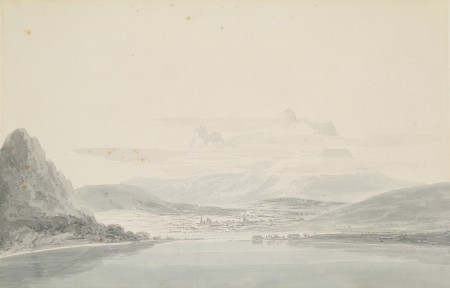
The watercolour was acquired by Turner at Monro’s posthumous sale in 1833, along with numerous other Continental subjects and it is now in the Turner Bequest at Tate Britain (probably Christie’s, 2 July 1833, lot 108). Unlike the majority of the drawings acquired from Monro’s collection, this example does not have an inscription recording its subject, and it is only now with the aid of Google Lens that it has been possible to identify the subject as the village of Fontaine-de-Vaucluse on the river Sorgue east of Avignon in the south of France. A small oil by Hubert Robert (1733–1808) dating from 1783 which shows the same spectacular rocky scenery with the Château des Évêques (Castle of the Bishops of Cavaillon) on the hill above provided the key to the identification of a scene known only as 'A River among Rocky Cliffs, with a Castle' (see figure 1).2 A pencil sketch in the Beaumont album of drawings and tracings at the Yale Center for British Art, New Haven, which provided the basis for so many of the Monro School subjects, shows a similar view further along the river minus the key detail of the castle and it is highly likely therefore that a missing Cozens prototype was again the source for this composition (see figure 2). However, given that it is not thought that Cozens returned overland from Italy through France, the more likely source for the composition was his father, Alexander Cozens (1717–86), who journeyed this way to or from Italy in 1746. Other Monro School subjects in the south of France, at Nice (TG0680) off the coast of Monaco (TG0682) and the bridge at nearby Avignon (TG0991) appear to have been made after compositions by Alexander, though as here it is possible that Girtin and Turner worked from an intermediary copy by John Robert.
In addition to giving the colouring of the work to Turner, Andrew Wilton has suggested in the online catalogue of the Turner Bequest that ‘the pencil underdrawing’ is also ‘very possibly by Turner’ (D36551). However, I remain unconvinced that this drawing is any different from the mass of works produced at Monro’s house. Though it is far from being of the highest quality, in terms of both the application of washes and the pencil work, I see no compelling reason to suggest that this one example departs from the two artists’ general practice. Who can say what time pressures they laboured under? This alone might account for a foreground river that is difficult to read.

1794 - 1797
A View of Nice, with Mont Alban Beyond
TG0680

1794 - 1797
A Ship off a Mountainous Coast, Known as 'Monaco'
TG0682

1794 - 1797
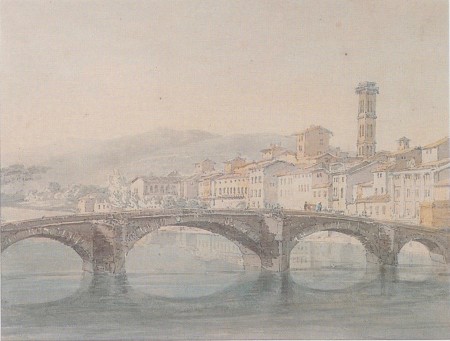
The Bridge at Avignon
TG0991






About this Work
This view of Fontaine-de-Vaucluse on the river Sorgue displays many of the signs that mark the unique collaboration between Girtin and his contemporary Joseph Mallord William Turner (1775–1851) at the home of Dr Thomas Monro (1759–1833). Here they were employed across three winters, probably between 1794 and 1797, to make ‘finished drawings’ from the ‘Copies’ of the ‘outlines or unfinished drawings of Cozens’ and other artists, amateur and professional, either from Monro’s collection or lent for the purpose. As the two young artists later recalled, Girtin generally ‘drew in outlines and Turner washed in the effects’. ‘They went at 6 and staid till Ten’, which may account for the generally monochrome appearance of the works, and, as the diarist Joseph Farington (1747–1821) reported, Turner received ‘3s. 6d each night’, though ‘Girtin did not say what He had’ (Farington, Diary, 12 November 1798).1