

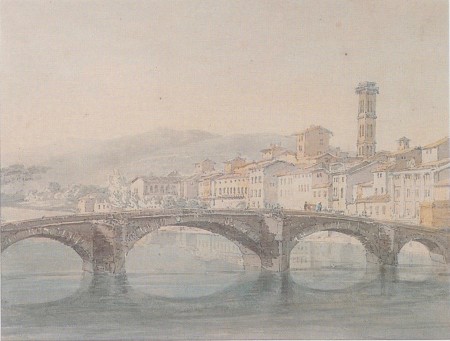
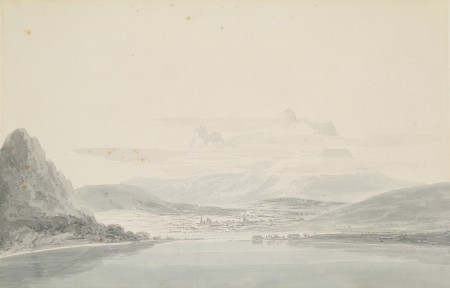
The album containing this drawing was sold in 1833 as the work of Turner, but the cataloguer of the Turner Bequest, Alexander Finberg, thought that Girtin alone was responsible for the watercolours, whilst more recently Andrew Wilton has established their joint authorship (Finberg, 1909, vol.2, p.1227; Wilton, 1984a, pp.8–23). Identifying the division of labour within Monro School drawings is considerably helped, as here, when the colour washes leave much of the pencil work showing through. An architectural subject generally requires a more detailed underdrawing than a landscape, and in this case Girtin’s inventive and fluent hand is clearly apparent under Turner’s economical use of a simple monochrome palette of blues and greys.

1794 - 1797
Albano: A Mausoleum, Known as the Tomb of the Horatii and Curatii
TG0614

1794 - 1797
Albano: The Ruins of a Mausoleum, Known as the Tomb of the Horatii and Curatii
TG0615






About this Work
This view of a hermitage on the Via Appia (Appian Way) at Albano is mounted in an album of watercolours bought by Joseph Mallord William Turner (1775–1851) at the posthumous sale of Dr Thomas Monro (1759–1833) (Christie’s, 28 June 1833, lot 78). The sixty-four drawings were the outcome of a unique collaboration between Girtin and Turner working together at Monro’s London home at the Adelphi. Here the artists were employed across three winters, probably between 1794 and 1797, to make ‘finished drawings’ from the ‘Copies’ of the ‘outlines or unfinished drawings of Cozens’ and other artists, amateur and professional, either from Monro’s collection or lent for the purpose. As the two young artists later recalled, Girtin generally ‘drew in outlines and Turner washed in the effects’. ‘They went at 6 and staid till Ten’, which may account for the generally monochrome appearance of the works, and, as the diarist Joseph Farington (1747–1821) reported, Turner received ‘3s. 6d each night’, though ‘Girtin did not say what He had’ (Farington, Diary, 12 November 1798).1
As with the majority of the views of the Roman Campagna completed at Monro’s home, it has not been possible to trace the source of this view of the well-known hermitage at Albano, which was fashioned from the stones of the adjacent Roman ruins. In general, Girtin and Turner worked from compositions by John Robert Cozens (1752–97) and, more specifically, from sketches and tracings that he made during or after his stay in Italy from November 1776 through to March 1779. Few of these survive, but the auction of the artist’s work held in July 1794 contained twenty-seven ‘books of sketches’ and many hundreds of drawings made on his travels, and, as Kim Sloan has argued, given that Monro’s posthumous sale included only a few sketches by Cozens, the patron must have borrowed the bulk of the material from which Girtin and Turner produced works such as this (Sloan and Joyner, 1993, pp.81–82). The building is located close to the so-called Tomb of the Horatii and Curiatii (seen in TG0614 and TG0615), on the outskirts of Albano, and it provided a picturesque subject for numerous British artists, amateur and professional. Cozens’ contemporaries who produced such views included Girtin’s later patron Sir George Beaumont (1753–1827) (see figure 1), John ‘Warwick’ Smith (1749–1831) and Thomas Jones (1742–1803), the last of whose very similar sketch is dated 5 May 1777 (see figure 2).